
If you've booked travel, chances are you've utilized Sabre's Global Distribution Database which powers major online travel agencies and brands globally. The mission-critical Sabre system provides live access to consolidated travel data from airlines, hoteliers, rail systems, and car rental companies. Sabre responds to over 25 Million travel requests an hour, serves over 750 PETABYTES of data each day, and processes over 9 Billion travel Itineraries each year.
ESTABLISHED THE UX DESIGN CENTER OF EXCELLENCE
In 2017, I successfully established the UX Design Center of Excellence (COE) at Sabre. I applied a hybrid-COE model with 10 embedded design teams in order to provide high-quality product strategy and design support and realize the financial/budgeting, consistency and retention benefits of a centralized team. This COE team averaged 80 staff across studios in the USA, Krakow and Bangalore.

Significantly upgraded product design across the portfolio:
-
Planned, redesigned and rigorously tested over 40 Sabre products with streamlined workflows and modern design patterns
-
System Usability Scale (SUS) scores averaging 85-90 points for products our team supported
-
Task completion improvement rates of over 30% for application workflows tested
-
30-40% improved time on task for key user behaviors.
Integrated leading design practices into the SDLC
-
Integrated UX research, design and validation into the SDLC resulting in a 30-40% reduction of rework hours and sprint cycles
-
UX Service design efforts yielded significant process improvements including 30% reduction of an 18 month installation and integration process for one of our most complex products.
-
90%+ annual stakeholder satisfaction scores for the UX COE across all Sabre business units

Refining a prototype with designers from USA and Bangalore-based teams
WORKED ON BOTH THE STRATEGIC AND TACTICAL LEVEL ACROSS THE PRODUCT PORTFOLIO
As leader of the UX Design COE, I regularly worked with my team members across all products, at all levels to review and refine UX concepts and new interface designs.
Personal Responsibilities:
-
Product Strategy, UX/Creative direction (IA, Workflow, Visual Hierarchy, application of EDL, etc. )
-
Concept and UI review of all significant deliverables across the portfolio
-
Reviewed and proofed all new product demos and prototypes
-
Frequent usability testing participant
-
Team mentorship at both Junior and Senior levels
INTRODUCED A REFRESHED DESIGN SYSTEM
Sabre had contracted a third-party design agency to develop an Enterprise Design Language just prior to my arrival at Sabre. This EDL was extended and applied to the Sabre product portfolio for 3 years.
In 2019, we decided to update the design system with the internal team to achieve several objectives:
-
Update the look & feel to meet modern application design trends
-
Accommodate a broader range of application interface requirements
-
Account for complex, data–dense application requirements
-
Improve data visualization standards
-
Meet current and future Digital Accessibility requirements


Market-based Design System component assessment.
Our updated system, named KATANA, was launched in 2020 and currently contains over 55 fully designed and coded UI components (Java and React versions). All new Sabre products are being designed with this system.
Sabre Products pre-2015
UI designers worked independently
with no design standards
Sabre Products 2016 - 2019
V1 of Sabre’s Enterprise Design Language was introduced and applied to all new product UI’s
Sabre Products 2020 - Present
Katana, an updated Design System was designed, built and introduced to upgrade the design aesthetic, improve usability and accessibility and accommodate complex, data-dense UI’s


CREATED A COMPREHENSIVE RESEARCH-BASED PERSONA LIBRARY
The Sabre UX Research team conducted over 250 studies across the product portfolio annually. In order to capture key insights about our user base as well as the applications tested, I had the team create a library of persona profiles based on their research insights.
This searchable library of over 60 distinct user types became a valuable internal asset for the product, development and UX design teams worldwide.

LAUNCHED DIGITAL ACCESSIBILITY TO IMPROVE USABILITY AND REDUCE RISK
Sabre’s broad product portfolio spans both B2C and B2B domains across airlines, travel agencies and hoteliers. In 2019, I spearheaded a Digital Accessibility initiative within Sabre to improve the overall user experience, ensure our products met current and near-future Digital Accessibility standards and reduce risk of litigation.
Today, the program is mature with Sabre’s Tier 1 (High-Risk) products meeting WCAG 2.1AA compliance requirements in addition to having Accessibility auditing and remediation built into the software development process. Tier 2 and 3 Products (medium to low risk) have auditing and process improvement roadmaps in place for 2022-23 compliance.
The program has been adopted by the Sabre Product and Development organizations and is managed by the UX COE who provides training support, audit tools training (Level Access) and compliance reporting.

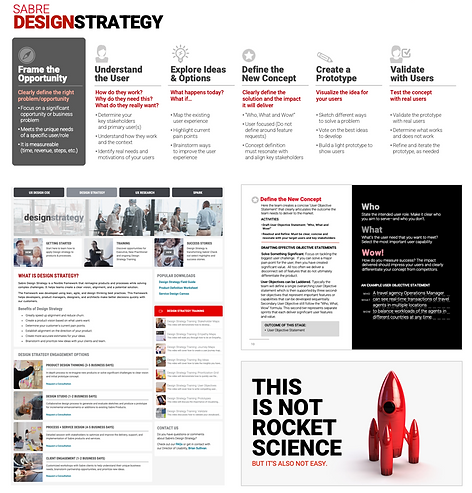
LAUNCHED SABRE DESIGN STRATEGY TO SPUR INNOVATION GLOBALLY
In order to formalize the UX team’s participation in early stage product planning and design, I worked with our team to build and launch our own Sabre Design Strategy framework. This effort, based on IDEO and IBM Design Thinking methods, was customized for the unique aspects of the Sabre culture, range of products and work processes.
The program was launched globally and I led training of over 1700 executives, designers, product leads and development teams across the United States, Asia (India/Singapore) and Europe (England/Poland).
The program continues to be well received by the business and has been a successful, highly-visible component of our team’s efforts. Sabre Design Strategy is now a required stage for all new product design and enhancement efforts and has also been used to reinvent Sabre services and business processes.
LED APPLICATION CO-CREATION WITH GLOBAL CLIENTS
The UX team at Sabre is continually adding new capabilities to the core product portfolio. One of our most effective approaches is to collaborate with our customers to define and prioritize new design requirements.
This example highlights Sabre’s Digital Workspace product that is used by front-line airline staff to facilitate reservations and operations management (passenger reservations, flight check-in, boarding, etc.).
The Sabre UX Design and Strategy teams worked with Digital Workspace users from 7 different global airline carriers to identify opportunities in IROPS and Loyalty for enhancing the overall experience for Reservation and Airport Agents.
The focus of the workshop included:
-
Enhancing agent notifications throughout the current user interface
-
Improving Irregular Operations (IROPS) workflow, when airplanes are delayed or canceled
-
Improving the Loyalty workflow for both airport and reservation agents.
The results were extremely positive this collaborative meeting has been repeated annually to design additional Digital Workspace workflows.

LED FIELD RESEARCH AND MODERNIZATION PLANNING
Flight Centre is one of the world’s largest travel retailers and corporate travel managers. The company, which is headquartered in Brisbane (Australia), has company-owned leisure and corporate travel business in 23 countries. Flight Center also is Sabre’s largest customer for the Sabre Red360 agent application.
In order to plan Phased 2 application design work, I led a team of UX Design strategy, UI design, and UX researchers to conduct field observations of Flight Centre agents using the current software at various sites across Australia and New Zealand. We also conducted executive and front-line user group design workshops as follows:
Administration Workflow
Review ways to optimize administrative activities (create, maintain, and support) the needs of travel agents and travel managers.
Corporate Workflow
Focus on streamlining the corporate workflow for agents to better serve business travelers and meet the needs of the corporations they serve.
Leisure Workflow
Evaluate the leisure agent workflow after the last implementation to identify current pain points and explore ways to improve the agent experience.
User Field Observations
Between workshops, the team performed user observations and interviews to validate the findings from the design strategy workshops.

